
Don't Think of a Pink Elephant
Don’t think of a pink elephant.
Too late?
Before you can avoid the image, your mind has to recognize it. For a moment, the pink elephant becomes the most noticeable thing in the room.
AI can run into a similar problem. Telling a model what not to do keeps the forbidden concept in plain sight. The restriction may end up shaping the response more than the task itself.
Why the pink elephant appears
Psychologists call this ironic process theory. One mental process looks for something else to think about, while another constantly checks whether the forbidden thought has returned. But that monitor can only do its job by keeping the concept active.
Research suggests that suppressed thoughts often rebound once conscious control relaxes, especially under heavy cognitive load.1 While suppression does not always fail, the monitoring process itself makes the unwanted thought remarkably accessible.
This is human psychology, not an explanation of neural networks. It is simply a useful comparison: trying to police a concept can keep that concept active.
Why negative instructions can backfire
An AI model generates responses one token at a time based on the text currently in its context. A negative instruction does not erase an idea; it writes that idea into the prompt, marks it with importance, and asks the model to avoid it.
Consider a common writing task:
Rewrite this customer email. Keep it concise. Do not add pricing.
The model might produce a clean email and then add: “Pricing has been omitted because the user asked not to include it.” No price appears, so the instruction is technically satisfied. But the recipient now knows information was withheld. The model overreacted to the constraint by explaining its own compliance.
Language models do not handle negative constraints reliably. They can struggle with negation across longer tasks,2 and mentioning a concept can make related words more likely to appear later.3 Important instructions can also get lost when a prompt contains too much context.4 Repeating what the model should avoid is not a good substitute for clearly stating what it should produce.
A better way to guide AI
Constraints still matter. But negative rules work far better when paired with a clear target, a focused context window, and a dedicated verification step.
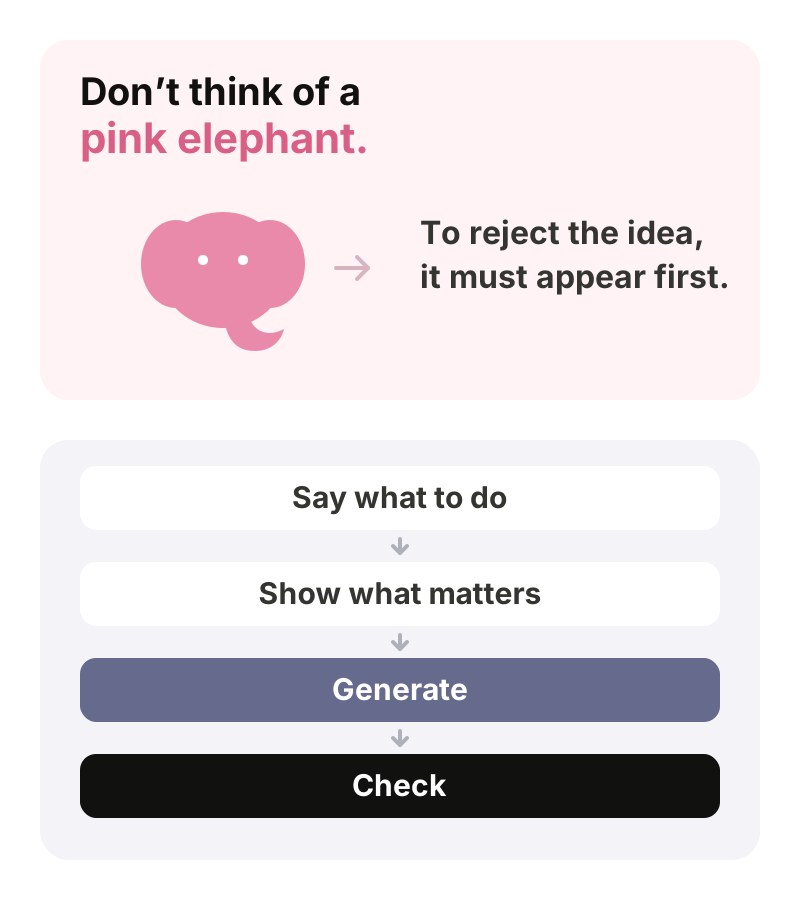
Clarify the objective, narrow the working context, and enforce constraints independently.
First, describe the outcome you want. Instead of leading with “Do not add pricing,” say, “Rewrite the email using only the product details provided.” Keep negative rules as quiet guardrails rather than primary instructions.
Next, restrict what enters the working context. A system can store extensive history in background memory while surfacing only the precise facts needed for the current step.
Finally, verify the output separately. A lightweight checker can inspect for prices, prohibited claims, or policy violations before the response is sent. The generator focuses on drafting while the verifier enforces the rules.
This reflects how we think about attention at Prelude. The real challenge is not just how much an AI can remember. It is whether the AI brings forward the right context when it matters and catches mistakes before they turn into actions.